
Triride vs Batec comparison
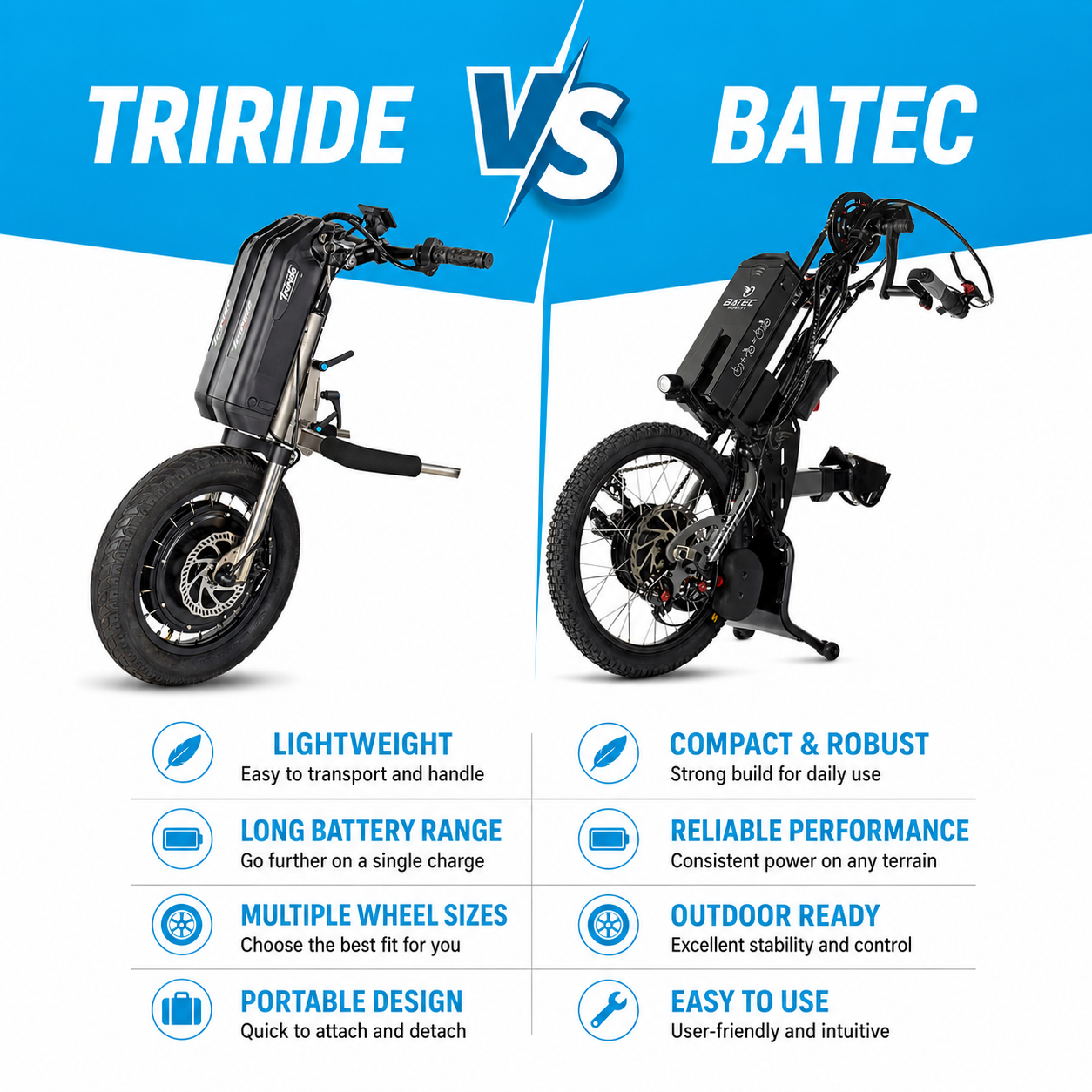
Triride vs Batec
Choosing an electric power attachment can make a major difference to how you use your manual wheelchair.
Two well-known options are Triride and Batec. Both turn a manual wheelchair into a more powerful mobility solution, but they approach design, portability, performance and everyday use differently.
In this Triride vs Batec comparison,
We look at the key factors that matter when choosing a wheelchair power attachment.
These include weight, wheel size, battery range, power, portability, outdoor performance, comfort and ease of use.
Because both brands offer several models, specifications can vary between individual products.
Therefore, the comparison below focuses on the general strengths of each brand, with the Triride Special Compact HT and current Batec electric models used as useful examples.
Need help deciding what might work for you?
If you’d like personalised guidance based on your wheelchair setup or mobility needs,
a specialist from Invictus Active can help.
Need help deciding what might work for you?
If you’d like personalised guidance based on your wheelchair setup or mobility needs, a specialist from Invictus Active can help.
The Triride Wins – And The Below Explains Why
When comparing Triride vs Batec wheelchair power add-ons,
both brands offer practical solutions for wheelchair users who want additional power, mobility and greater independence.
However, when the key factors are performance, configuration options, handling, flexibility and everyday usability, we believe the Triride is the stronger overall choice.
Triride has developed a range of wheelchair power add-ons designed to give active wheelchair users more freedom without changing the core benefits of their manual wheelchair.
Its range includes different configurations and performance levels,
making it easier to find a setup suited to individual mobility requirements.
Batec also provides powered handcycle solutions with a strong focus on assisted mobility. However, when the two brands are compared feature by feature,
Triride offers more advantages across the areas that matter most to many active wheelchair users.
| Feature | Triride | Batec |
|---|---|---|
| Wheelchair power add-on | ✓ | ✓ |
| Multiple models and configurations | ✓ | ✓ |
| Lightweight options available | ✓ | — |
| Compact design options | ✓ | — |
| Performance-focused models | ✓ | ✓ |
| Suitable for active wheelchair users | ✓ | ✓ |
| Flexible configuration choices | ✓ | — |
| Easy attachment to wheelchair | ✓ | ✓ |
| Choice of power and performance levels | ✓ | ✓ |
| Designed for everyday mobility | ✓ | ✓ |
| Broad range of solutions | ✓ | — |
| Customisation potential | ✓ | — |
| Strong outdoor capability | ✓ | ✓ |
| Transport-friendly options | ✓ | — |
| Overall comparison | ✓ Winner | — |
Always check the exact model specification before purchase because equipment, battery, wheel size and range vary between models.
Triride vs Batec: Quick Comparison
Always check the exact model specification before purchase because equipment, battery, wheel size and range vary between models.
What Is a Wheelchair Power Attachment?
A wheelchair power attachment connects to the front of a manual wheelchair and provides electric assistance through a powered wheel.
Instead of pushing the wheelchair entirely by hand, the user can use a handlebar and motor to travel with less physical effort.
Both Triride and Batec follow this basic concept.
However, their product ranges differ in size, configuration and intended use.
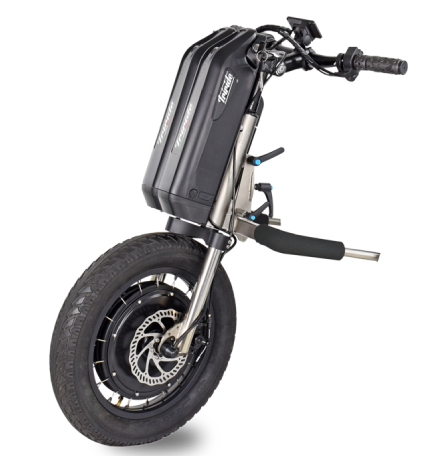
For example, Triride’s Special Compact HT has a 12-inch wheel, 75 Nm of torque, a transport weight from 11 kg excluding the battery and connection arms, and a claimed range of up to 50 km under specified test conditions.
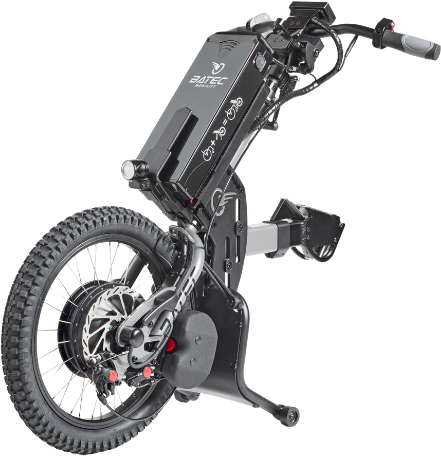
Batec offers a wider range of designs. Its current products include compact options such as the Batec Air, as well as larger electric and outdoor-focused models.
Batec states that its handbikes are compatible with around 95% of manual wheelchairs, subject to compatibility checking.
Triride: Lightweight and Compact Design
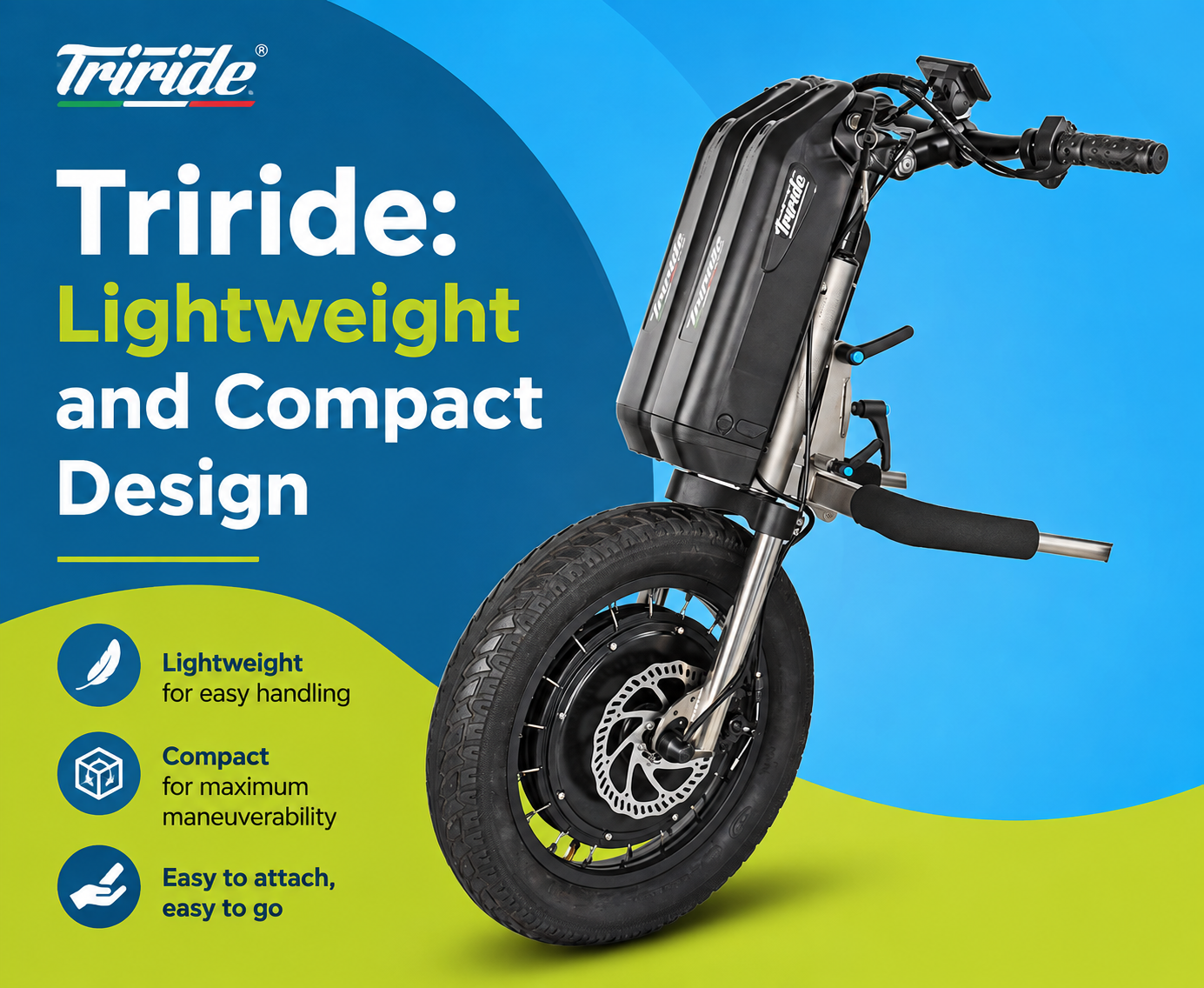
Triride is particularly interesting for wheelchair users who place a high value on weight and portability.
The Special Compact HT uses a 12-inch wheel and weighs from 11 kg before adding the battery and wheelchair connection arms.
It also provides 75 Nm of torque, which makes it an attractive option for users who need strong assistance while keeping the attachment relatively compact.
The system offers Normal and Sport driving profiles, Eco Drive, reverse, cruise control and five selectable power levels.
The Allroad version can also use a wider Cross tyre for more demanding surfaces.
This combination makes Triride worth considering if you regularly need to load your power attachment into a vehicle or want a compact solution for everyday mobility.
Triride Pros
⇒ Lightweight design
⇒ Compact overall package
⇒ High torque on the Special Compact HT
⇒ 36 V or 48 V battery options
⇒ Up to 50 km claimed range on the Special Compact HT
⇒ Normal, Sport and Eco Drive modes
⇒ Reverse and cruise control
⇒ City and Cross tyre choices
⇒ Allroad version available
⇒ Customisable configuration
Triride Cons
⇒ Exact weight depends on the configuration and battery
⇒ Different Triride models have different performance levels
⇒ Smaller wheels may not suit every type of terrain
⇒ Some useful accessories and configurations can add to the overall cost
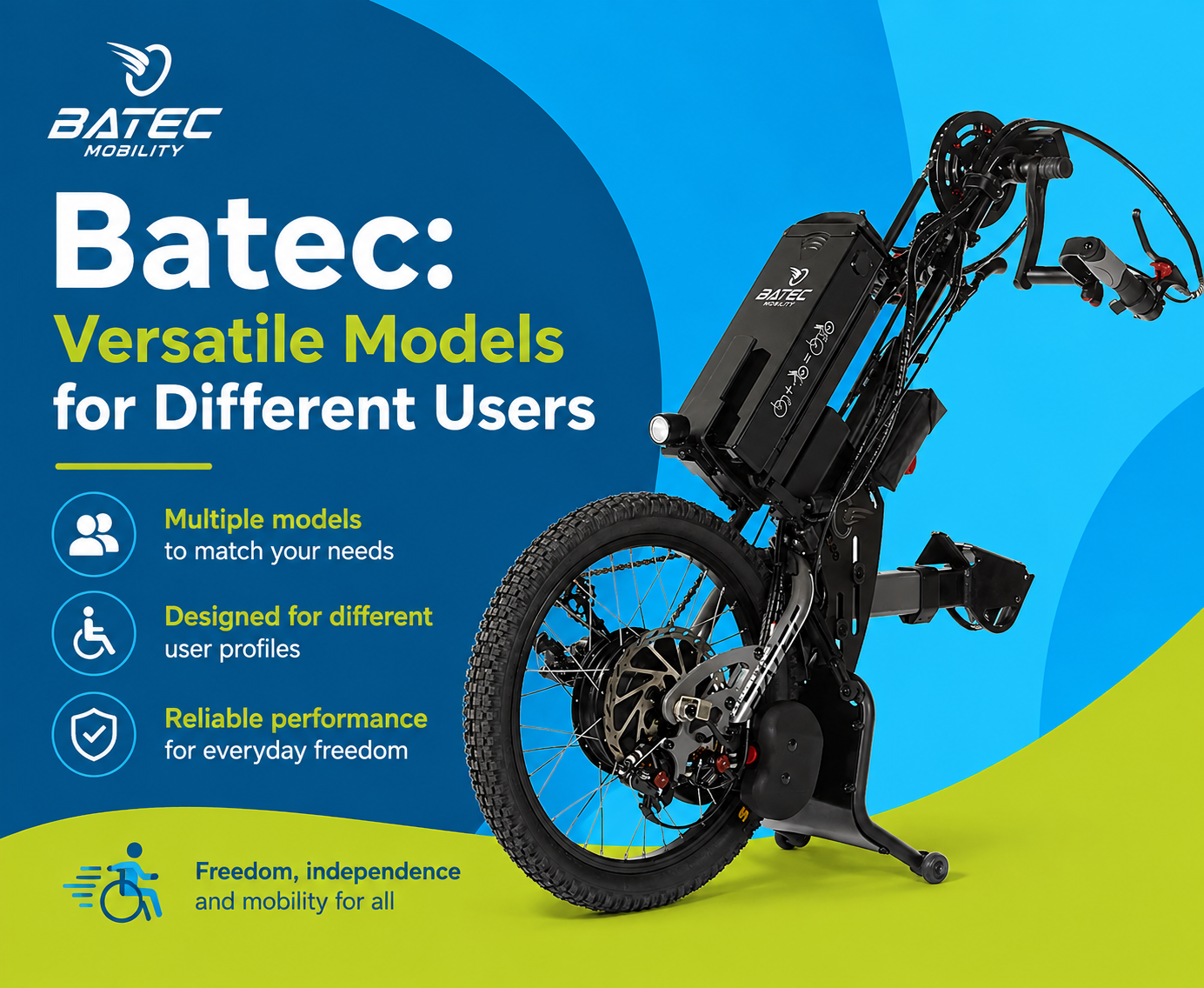
Batec: Versatile Models for Different Users
Batec takes a broader approach with its electric handbike range.
Rather than offering one type of power attachment, the brand has different models designed around compact travel, everyday mobility and more demanding outdoor use.
For example, the Batec Air has a 10-inch wheel, weighs 11 kg without the battery and uses a 216 Wh battery.
Batec quotes up to 23 km of autonomy under its stated test conditions.
It also features a folding design, reverse gear, TFT colour display, front lighting and rear LED lights.
At the other end of the range, the Batec Rapid 2 Plus uses an 18-inch wheel, weighs 15.9 kg without the battery and can use a 768 Wh battery.
Batec quotes up to 55 km of autonomy under specified test conditions.
This wider choice means Batec can be attractive if you want to select a handbike around your particular riding style.
Batec Pros
⇒ Wide range of models
⇒ Compact Batec Air option
⇒ Larger-wheel options for outdoor riding
⇒ Several battery capacities
⇒ Reverse gear on current models
⇒ Cruise control on many models
⇒ Electronic braking on current models
⇒ Anti-slip technology on selected models
⇒ Strong focus on wheelchair compatibility
⇒ Models for different types of terrain
Batec Cons
⇒ Larger models can be considerably heavier
⇒ Battery and model selection can make comparisons more complicated
⇒ Some configurations may be less convenient to transport than a compact Triride
⇒ The best choice depends heavily on the exact Batec model
Weight and Portability: Triride vs Batec
Weight can be one of the most important factors when choosing a wheelchair power attachment.
A lightweight attachment is easier to lift, store and transport.
This becomes particularly important if you regularly put the device into a car.
The Triride Special Compact HT starts at 11 kg before the battery and wheelchair connection arms.
Batec also offers lightweight options. The Batec Air, for example, weighs 11 kg without its battery. However, larger Batec models are heavier.
The Electric 2 Plus weighs 15.9 kg without the battery, while the Rapid 2 Plus also weighs 15.9 kg without the battery.
Winner for compact portability: Triride, particularly when comparing lightweight configurations.
However, the Batec Air deserves consideration if you specifically want a compact Batec.
Range and Battery Options
Battery range depends on much more than the advertised maximum figure.
User weight, speed, hills, tyre pressure, road surface, temperature, battery condition and driving style can all affect real-world range.
The Triride Special Compact HT has 36 V and 48 V lithium-ion battery options and a claimed range of up to 50 km under specified conditions.
Batec’s range varies significantly between models and battery options.
Its current handbike range generally covers approximately 20–50 km, although individual models can quote different figures.
For example, the Batec Air is quoted at up to 23 km with its 216 Wh battery, while the Rapid 2 Plus can reach up to 55 km with a 768 Wh battery under Batec’s stated conditions.
Winner for range: It depends on the model and battery. Compare the exact configuration rather than the brand alone.
Wheel Size and Outdoor Performance
Wheel size affects how a power attachment feels on different surfaces.
Smaller wheels can help create a compact setup, while larger wheels can provide advantages when travelling over uneven surfaces.
The Triride Special Compact HT uses a 12-inch wheel.
Its Allroad version adds a 12 × 3.00 tyre designed for more demanding and uneven routes.
Batec provides considerably more choice.
Current models include the 10-inch Batec Air, 12-inch Batec Mini 2 Plus, 18-inch Electric 2 Plus and Rapid 2 Plus, plus larger-wheel options such as the 19-inch Scrambler 2 Plus and 20-inch Hibrid 2.
Winner for wheel-size choice: Batec.
Power and Hill Performance
Torque matters when you regularly encounter slopes, ramps or challenging surfaces.
The Triride Special Compact HT produces 75 Nm of torque.
Triride specifically positions this model around high-torque performance and demanding inclines.
Batec’s motor output varies between models.
For example, the current Electric 2 Plus lists a 900 W rated motor with 1050 W peak power, while Batec’s other models use different motor and wheel configurations.
Therefore, it is not useful to declare one brand universally more powerful. Instead, compare the exact motor, torque, wheel, battery and user requirements.
Which Should You Choose: Triride or Batec?
Choose Triride if your priority is a lightweight, compact power attachment with strong torque and extensive configuration options.
The Special Compact HT is particularly appealing for users who want 75 Nm of torque without moving to a much larger handbike.
Choose Batec if you want a larger selection of models and wheel sizes.
The range includes compact products such as the Batec Air as well as larger models designed for longer journeys and outdoor riding.
Choose Triride if:
⇒ You prioritise low transport weight.
⇒ You frequently load the handbike into a car.
⇒ You want a compact attachment.
⇒ You value customisation.
⇒ You want strong torque from a compact model.
⇒ You prefer a 12-inch high-torque configuration.
Choose Batec if:
⇒ You want more model and wheel-size choices.
⇒ You want a compact Batec Air.
⇒ You prefer larger wheels for certain outdoor routes.
⇒ You want different battery capacity options.
⇒ You want to select a model around your particular riding style.
⇒ You value a broad compatibility range.
Triride vs Batec: Our Verdict
There is no single winner for every wheelchair user.
Triride is the stronger choice for users who prioritise lightweight portability, compact design and high torque.
The Special Compact HT combines an 11 kg starting transport weight with 75 Nm of torque and up to 50 km of claimed range under specified conditions.
Batec is the stronger choice for users who want variety.
Its current range covers compact, everyday and larger outdoor-focused designs, giving users more choice over wheel size, battery and riding characteristics.
Ultimately, the right wheelchair power attachment should match your wheelchair, body position, typical terrain, transport needs and daily travel distance.
Before making a final decision, check wheelchair compatibility and the exact specification of the model you are considering.
Frequently Asked Questions
Is Triride better than Batec?
Neither brand is universally better.
Triride can be a strong choice for lightweight portability and high torque, while Batec offers a broader range of models and wheel sizes.
How far can a Triride travel?
The Triride Special Compact HT has a claimed range of up to 50 km.
The actual range depends on factors such as user weight, speed, terrain, battery condition and road surface.
How far can a Batec travel?
Batec range depends on the model and battery.
The manufacturer states that its handbikes generally offer around 20–50 km of range, while individual models can provide different figures.
Which has the bigger wheel, Triride or Batec?
It depends on the models being compared.
The Triride Special Compact HT uses a 12-inch wheel, while Batec offers models ranging from 10-inch to 20-inch wheels.
Is Triride suitable for hills?
The Triride Special Compact HT is designed as a high-torque model with 75 Nm of torque.
Its manufacturer specifically highlights demanding inclines and uneven routes, particularly with the Allroad configuration.
Which is easier to transport in a car?
A compact, lightweight configuration will generally be easier to transport.
Triride’s Special Compact HT starts at 11 kg excluding the battery and connection arms, while Batec offers the 11 kg Batec Air without its battery. Larger Batec models are heavier.
Should I choose a Triride or Batec power attachment?
Start by comparing your wheelchair compatibility, required range, typical terrain, transport method, preferred wheel size and the amount of assistance you need.
A product demonstration can also help you decide which attachment feels most comfortable and controllable.